



Do You Need a Sinus Lift Before Getting Dental Implants?
Not everyone getting a dental implant needs a sinus lift. It may be considered when an implant is planned for the back of the upper jaw and there is not enough bone beneath the maxillary sinus to support it properly. The deciding factors are your anatomy, the amount and quality of bone that remains, and the position of the planned implant — not simply how long the tooth has been missing.
That decision cannot be made from symptoms, the length of time a tooth has been missing, or a single number seen online. Dentists assess the remaining bone, sinus anatomy, condition of the surrounding tissues and the planned implant position using a clinical examination and appropriate dental imaging.
At Maple Dental Health, implant treatment is provided within a multidisciplinary dental team that includes Dr. Carly Gordon, Dr. Lulu Shen, Dr. Jane Wu, Dr. Joseph Ramos, Dr. Katrin Spassov and Dr. Mirette Mounir. The practice lists both dental implant treatment and bone grafting among its clinical services.
That being said, a clinical examination and dental imaging are needed to determine whether sinus augmentation is actually necessary.
Table of Contents
- What is a sinus lift?
- Why might you need one before a dental implant?
- How does a dentist decide whether you need a sinus lift?
- How much bone do you need for a dental implant?
- What happens during a sinus lift?
- Can a sinus lift and dental implant be done at the same time?
- How long after a sinus lift can you get an implant?
- What is sinus lift recovery like?
- What are the risks?
- Does every upper dental implant require a sinus lift?
- What if you do not have enough bone?
- Why Tooth-Loss History Helps — But Doesn't Decide the Treatment
- Considering dental implants near Woodbridge or Kleinburg?
- Frequently asked questions
What Is a Sinus Lift?
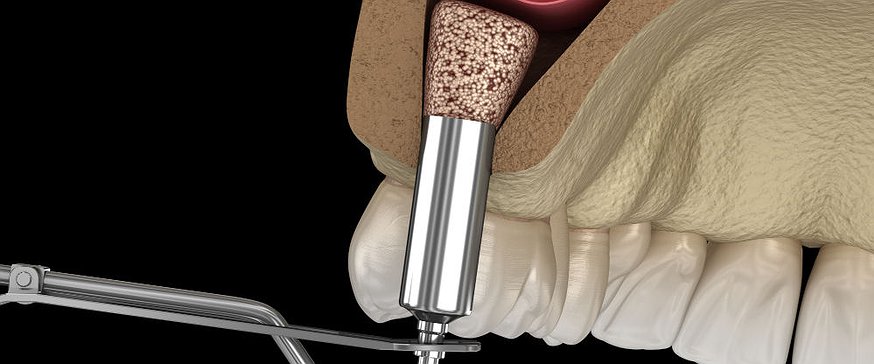
A sinus lift, also called sinus augmentation or sinus floor elevation, is a procedure used to increase the amount of bone available in the back portion of the upper jaw.
The reason has a lot to do with anatomy.
Your maxillary sinuses are air-filled spaces located above the upper premolars and molars. In some people, there is plenty of jawbone between the roots of those teeth and the floor of the sinus. In others, the space is naturally much smaller.
Once an upper back tooth is gone, the amount of usable bone may reduce further.
During a sinus lift, the membrane lining the sinus is carefully elevated and space is created beneath it. Depending on the technique and treatment plan, grafting material may then be used to build additional bone in the area where an implant needs support.
The important point is that a sinus lift is not an automatic step in implant treatment. Its purpose is to deal with a specific anatomical problem: too little suitable bone in the posterior upper jaw.
Why Would You Need a Sinus Lift Before a Dental Implant?
An implant relies on surrounding bone for support. In the upper molar and premolar region, there may not always be enough vertical bone between the mouth and the sinus.
There are several reasons this can happen.
The tooth has been missing for some time
Bone changes after a tooth is removed because the socket and surrounding ridge are no longer supporting a natural tooth root.
Research has documented loss of ridge dimensions following extraction, while studies of the posterior upper jaw have also examined changes around the maxillary sinus after tooth loss. The exact contribution from ridge resorption and sinus expansion varies between patients, which is one reason treatment cannot be planned from the length of time a tooth has been missing alone.
For someone asking whether it is still possible to get a dental implant years after losing a tooth, the answer may be yes — but the remaining bone has to be assessed first.
Your sinus naturally sits close to the jaw
Some people simply begin with less vertical bone beneath the sinus.
That means a patient who lost an upper molar relatively recently can sometimes have less implant-supporting bone than someone whose tooth has been missing considerably longer.
Anatomy matters more than assumptions.
Previous periodontal disease has reduced bone support
Periodontal disease can damage the bone around teeth. If substantial bone has already been lost before an extraction, the site available for a future implant may be more limited.
Infection, extraction or previous treatment altered the area
The shape of the remaining ridge can also differ depending on the original tooth, previous infection, extraction history and healing.
None of these factors means that a sinus lift is inevitable. They simply give the dentist a reason to look more carefully at the available bone.
How Does a Dentist Know Whether You Need a Sinus Lift?
This is the part of implant planning that matters most.
You generally cannot tell from symptoms whether you need a sinus lift. There is also no reliable rule such as, “My tooth has been missing for five years, so I must need grafting.”
The question is not simply whether there is some bone beneath the sinus. The dentist needs to know whether there is enough suitable bone, in the right position, to support the implant and the tooth that will eventually be attached to it.
“When we assess an implant in the upper back jaw, we’re not looking at one measurement in isolation. We need to understand how much usable bone is present, where the sinus sits, and whether the implant can be positioned with the support it needs. Some patients require sinus augmentation, while others have enough native bone to proceed without it.”
— Dr. Carly Gordon, Dentist and Owner, Maple Dental Health
That assessment brings several pieces of information together rather than relying on a single measurement.
The assessment usually combines:
| What is assessed | Why it matters |
|---|---|
| Location of the missing tooth | Sinus anatomy is primarily relevant to implants in the posterior upper jaw |
| Height and width of remaining bone | The implant needs adequate surrounding support |
| Bone quality | Bone volume alone does not tell the whole story |
| Position of the maxillary sinus | Determines how much space is available beneath it |
| Shape of the ridge | Influences implant positioning and surgical planning |
| Neighbouring teeth and gums | Existing disease or structural problems may affect the treatment plan |
| Medical and dental history | Healing and surgical risk vary between patients |
| Proposed restoration | The implant has to be positioned to support the final tooth properly |
Dental X-rays may provide useful information, and 3D cone-beam computed tomography (CBCT) may be used when clinically indicated to assess the area in greater detail.
The objective is not merely to find enough space to insert an implant.
The implant needs to sit in a position that provides suitable bone support and makes sense for the crown or other restoration that will eventually be attached to it.
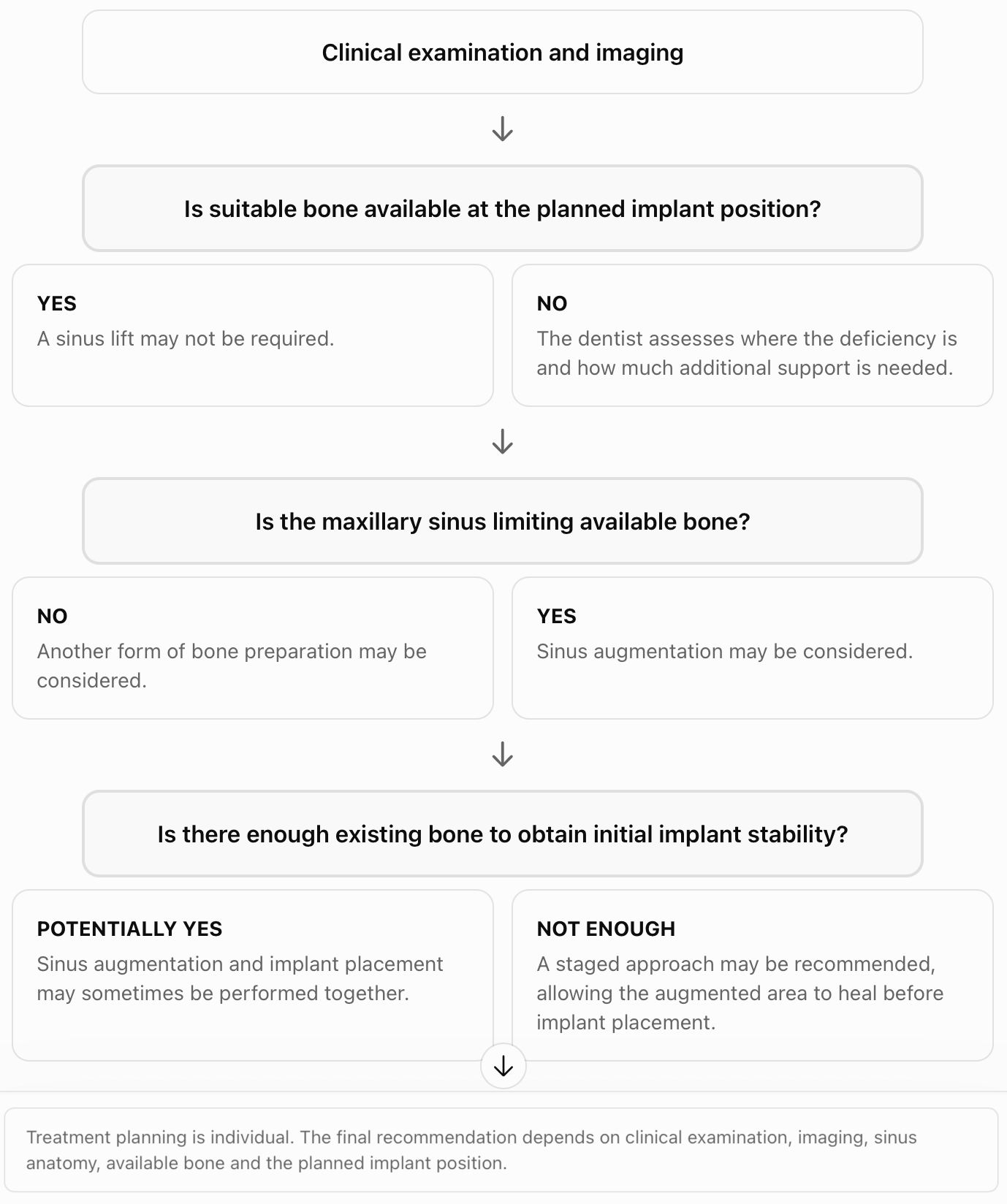
The sinus-lift decision in one view
Upper back tooth needs replacement
↓
Clinical examination and imaging
↓
Is suitable bone available at the planned implant position?
Yes → A sinus lift may not be required.
No → The dentist assesses where the deficiency is and how much additional support is needed.
↓
Is the maxillary sinus limiting available bone?
No → Another form of bone preparation may be considered.
Yes → Sinus augmentation may be considered.
↓
Is there enough existing bone to obtain initial implant stability?
Potentially yes → Sinus augmentation and implant placement may sometimes be performed together.
Not enough → A staged approach may be recommended, allowing the augmented area to heal before implant placement.
That is why two patients replacing the same upper molar can leave an implant consultation with different treatment plans.
Here is a diagram for your convenience:
How Much Bone Do You Need for a Dental Implant?
There is no useful universal number that allows a patient to look at an X-ray measurement and decide whether a sinus lift is necessary.
Implant dimensions vary. So does bone quality. The position of the implant, shape of the ridge, anatomy of the sinus and surgical approach all influence what can reasonably be done.
A measurement that permits one treatment approach in one person may lead to a different recommendation in another.
This is also why online rules such as “you need X millimetres of bone” should be treated cautiously when applied to an individual case.
The clinically useful question is not:
“Do I have a certain number of millimetres?”
It is:
“Is there enough suitable bone, in the right place, to support the implant that is being planned?”
What Happens During a Sinus Lift?
The details vary according to the technique being used and how much additional bone is required, but the basic idea is straightforward.
The area is anaesthetized. The clinician gains access to the bone beneath the sinus and carefully elevates the sinus membrane, creating space between the membrane and the existing jawbone.
Grafting material may then be placed within this newly created space so that a greater volume of bone can develop.
The site is closed and allowed to heal.
There are different approaches to sinus floor elevation. A larger deficiency and a relatively small deficiency do not necessarily call for the same procedure, which is another reason a description of “the sinus lift procedure” can be misleading if presented as though every operation were identical.
A systematic review of sinus-floor-elevation complications also found that complication patterns differ according to the technique used.
Can the Sinus Lift and Dental Implant Be Done at the Same Time?
Sometimes.
This decision often comes down to how much usable bone already exists.
Even when augmentation is required, there may be enough native bone to give the implant adequate initial stability. In an appropriate case, the dentist may therefore be able to perform sinus augmentation and implant placement during the same treatment stage.
In another patient, the existing bone may not provide enough support for that approach.
The sequence may then look more like:
sinus augmentation → healing and bone development → reassessment → implant placement
Neither approach is automatically better. The relevant question is which sequence suits the anatomy and provides a sound foundation for the planned implant.
How Long After a Sinus Lift Can You Get a Dental Implant?
When the implant is not placed during the sinus augmentation procedure, the grafted area needs time to heal and develop sufficient stability before the next stage is considered.
There is no single recovery period that applies to everybody.
Healing can be influenced by the extent of augmentation, existing bone, gum and periodontal health, smoking, general health and whether any complications occur.
For that reason, implant readiness should be determined by healing and clinical assessment rather than by promising a particular date in advance.
What Is Recovery Like After a Sinus Lift?
The early recovery period may involve some swelling, tenderness and minor bleeding around the surgical area. Some patients can also notice a feeling of pressure or congestion associated with the sinus region.
Postoperative instructions matter because the surgical site is close to the sinus.
Depending on the procedure, patients may be told temporarily to avoid activities that create substantial pressure within the nose or sinuses. Your own instructions take priority, since they depend on exactly what was performed.
This is also a good reason not to rely on a generic online recovery checklist. Someone who had a small internal elevation and someone who underwent more extensive augmentation may not receive identical instructions.
Contact the treating dental team if symptoms are becoming worse rather than better, or if you develop anything that your postoperative instructions identify as a reason for review.
What Are the Risks of a Sinus Lift?
Sinus augmentation is a surgical procedure, so potential complications need to be considered as part of informed treatment planning.
They can include:
- perforation of the sinus membrane;
- infection;
- swelling or bleeding;
- graft-related complications;
- sinus symptoms; and
- delayed or incomplete healing.
Membrane perforation is one of the most frequently studied complications. A 2023 systematic review and network meta-analysis included 85 studies and 5,551 sinus-floor-elevation procedures and found that perforation risk varied with the surgical method used.
Importantly, that finding does not provide an individual patient's risk. Technique, anatomy, medical history and the complexity of the case all matter.
A separate systematic review examining sinus-floor-elevation complications found postoperative pain, swelling and edema commonly reported, while complications requiring intervention varied between surgical approaches.
The purpose of discussing these risks is not to make a sinus lift sound alarming. It is to explain why the decision should be based on a proper assessment rather than treating grafting as a routine add-on.
Does Everyone Getting an Upper Dental Implant Need a Sinus Lift?
No.
Many upper-jaw implants can be placed without sinus augmentation because sufficient suitable bone is already present.
Depending on the site, another patient may require a different type of preparation instead, such as ridge augmentation or other [bone grafting for dental implants].
The options can look broadly like this:
| Clinical situation | What may be considered |
|---|---|
| Adequate bone below the sinus | Implant placement without sinus augmentation |
| Small site-specific bone deficiency | Treatment may involve a more limited augmentation approach |
| Sinus limits available posterior upper-jaw bone | Sinus augmentation may be considered |
| Significant deficiency with inadequate initial stability | Grafting followed by later implant placement may be considered |
| Bone deficiency elsewhere around the implant site | Another form of bone grafting or ridge augmentation may be more relevant |
This is also why “upper implant” and “sinus lift” should not be treated as synonyms.
What If I Don't Have Enough Bone for a Dental Implant?
Being told that there is insufficient bone does not necessarily mean that an implant is impossible.
It means the site needs more careful planning.
Where the deficiency is located matters. If the issue is limited bone height beneath the maxillary sinus, sinus augmentation may be one option. A deficiency elsewhere in the ridge may be treated differently.
Maple Dental Health also provides information about [bone grafting], which is the broader category of procedures used to rebuild or preserve bone for implant treatment. Sinus augmentation is one specific application in the upper posterior jaw.
There are also situations in which alternative implant approaches may be discussed instead of a sinus lift. Suitability depends on the individual anatomy and restorative plan rather than on a single finding on an X-ray.
Why Tooth-Loss History Helps — But Doesn't Decide the Treatment
It is reasonable to wonder whether waiting several years after losing a molar makes a sinus lift much more likely.
Time can matter because bone changes after extraction. However, it does not work like a countdown.
Research has shown changes in the posterior maxilla following extraction, although studies differ on how much of the reduction in available vertical bone should be attributed to ridge resorption versus expansion of the sinus itself. One CBCT study, for example, concluded that post-extraction vertical bone reduction was primarily associated with alveolar ridge resorption rather than continuing sinus pneumatization.
More recent evidence also suggests that preserving the extraction site can influence later treatment requirements. A 2025 systematic review and meta-analysis found that ridge-preservation procedures in the posterior maxilla were associated with greater preservation of ridge height and a reduced subsequent need for sinus-floor augmentation, although the authors noted that the evidence base remains relatively small.
For the patient sitting in the dental chair today, however, the practical question remains the same:
What anatomy is present now?
That is what treatment has to be planned around.
Considering Dental Implants Near Woodbridge or Kleinburg?
Patients from Woodbridge or Kleinburg considering an upper-jaw implant may need very different levels of preparation.
For one person, conventional implant placement may be possible. For another, bone grafting or sinus augmentation may need to be discussed first.
An implant assessment can establish how much bone is present, where the sinus sits and whether additional preparation should be considered before treatment.
Maple Dental Health provides [dental implant treatment for Woodbridge and Kleinburg patients] from its dental office in Maple, Ontario.
Frequently Asked Questions
Do all upper dental implants require a sinus lift?
No. A sinus lift is considered when there is insufficient suitable bone beneath the maxillary sinus for the implant being planned. Many patients already have adequate bone and do not require sinus augmentation.
How do I know if I need a sinus lift before an implant?
A dentist needs to examine the area and assess appropriate dental imaging. The remaining bone, position and anatomy of the sinus, implant location, gum health and final restoration all contribute to the decision. You cannot reliably determine the need for a sinus lift from symptoms alone.
Is a sinus lift the same as a bone graft?
Not exactly. Bone grafting is a broad term covering procedures used to rebuild or augment bone. A sinus lift is a specific form of augmentation involving the posterior upper jaw and maxillary sinus.
Can a sinus lift and dental implant be done at the same time?
Sometimes. Simultaneous treatment may be considered when enough native bone remains to provide suitable initial implant stability. If not, sinus augmentation may be completed first and the implant placed after adequate healing.
How long does a sinus lift take to heal before an implant?
There is no single timeline appropriate for every patient. Healing depends on factors including the amount of augmentation, existing bone, individual healing response, periodontal health, smoking and any complications. The treating dentist assesses when the site is ready.
Can I get dental implants without a sinus lift if I have bone loss?
Possibly. “Bone loss” can describe different anatomical situations. Some deficiencies may require another form of grafting, while some implant sites may still be suitable without augmentation. Imaging and clinical planning are required to determine the options.
What happens if there isn't enough bone for a dental implant?
The dentist first determines where the deficiency is and how it affects the planned implant. Possible approaches can include bone grafting, sinus augmentation or a different implant plan. Insufficient bone at the first assessment does not automatically rule out implant treatment.
Why are sinus lifts mainly associated with upper back teeth?
The maxillary sinuses sit above the posterior upper teeth. When an implant is planned in this region, the floor of the sinus can limit the amount of available vertical bone. This anatomical relationship does not exist in the same way in the lower jaw.
Can an X-ray tell whether I need a sinus lift?
Dental X-rays can provide useful information, but the type of imaging required depends on the case. When clinically indicated, 3D CBCT imaging can provide more detailed information about bone dimensions and sinus anatomy. Imaging is interpreted alongside a clinical examination rather than used in isolation.
Does having an upper molar missing for years mean I definitely need a sinus lift?
No. Bone commonly changes after tooth loss, but the amount of remaining bone and sinus anatomy differ significantly between patients. Someone who has had a tooth missing for years may still have sufficient bone, while another patient may have limited bone much sooner.
Is sinus augmentation always performed with a bone graft?
Techniques vary. Clinical studies have examined sinus-floor-elevation approaches both with and without grafting materials in selected circumstances. This is a treatment-planning decision, not something that can be generalized to every patient. A systematic review of randomized clinical trials has examined outcomes of sinus-floor elevation with and without graft material, underscoring that several approaches exist rather than one universal technique.
What is the most important thing to know before agreeing to a sinus lift?
Understand why it is being recommended in your particular case. Your dentist should be able to explain where the sinus is, how much suitable bone is available, why that affects the proposed implant and whether other approaches are relevant.
The Bottom Line
A sinus lift is not something every dental implant patient needs. It is considered primarily when the maxillary sinus leaves too little suitable bone for an implant planned in the back of the upper jaw.
The decision comes from anatomy and treatment planning — not from a symptom, a rule about how many years a tooth has been missing or a universal bone measurement.
If you are considering an upper-jaw dental implant, an implant assessment can determine how much bone is available, where the sinus sits and whether additional preparation such as bone grafting or sinus augmentation may need to be considered.
Contact Maple Dental Health to discuss your implant treatment options.